Bill’s Commentary:
“Always has and always will…”
History shows financial calamities occur when rates rise rapidly like this: ‘Something always breaks’
The yield on the 10-year Treasury note is rising to levels not seen in years. But it’s not necessarily the outright level that’s most concerning for those on Wall Street, it’s the speed of the move.
When rates climb at such a rapid pace, history tells them something bad tends to happen.
The 10-year yield saw its most rapid one-day increase since April 7, 2025, on Wednesday, rising further on Thursday to top 5.17%, quite a move considering two weeks ago it was below 4.8% and at one point in August, it was below 4.6%.
Bill’s Commentary:
“When higher rates break something… got gold?”
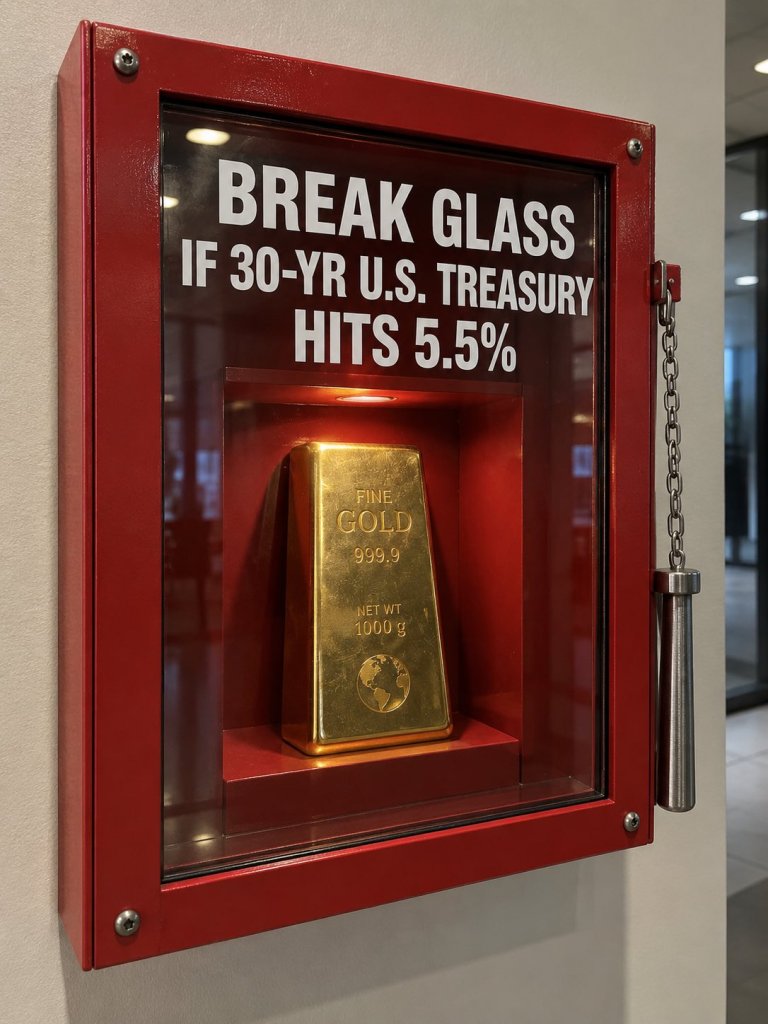
Bill’s Commentary:
“AI will not exist without silver… lots of it!”
One Sector. 2.58 Billion Ounces. AI’s Coming Silver Demand Shock
Artificial intelligence is transforming the global data-center industry into a faster, denser, and more materials-intensive system—and silver may be one of the overlooked beneficiaries.
The reason is simple: AI is a race for speed. Training and operating large AI models requires massive numbers of GPUs and other accelerators to move data continuously among processors, memory, storage, and networking equipment. Every millisecond matters. So do electrical losses, heat buildup, equipment reliability, and power-delivery efficiency.
Bill’s Commentary:
“You know the old saying, by the time mainstream figures it out, it is too late!”
Global debt tops $365 trillion as economists sound alarm over ‘vicious cycle’
- Governments are trapped in a “vicious cycle” as large deficits meet rising interest expenses but are not met by political will to tackle the situation, the Institute of International Finance has warned.
- The U.S., Japan, France and U.K. are facing the challenges typically met by emerging markets, while interest payments by advanced economies have topped global spending on AI, defense or clean technology.
- International Monetary Fund (IMF) chief Kristalina Georgieva said it is “impossible to stress strongly enough how critical it is” to bring down debt and prioritize fiscal consolidation.
Bill’s Commentary:
“Our pal Grizzly checks in and is absolutely correct!”
Mornin Bill,
> So what do you think big brother will do with the ability to control everything with digital currencies, cameras and spyware everywhere?
> Does that sound like a liberty bell ringing? Hardly. Griz
Bill’s Commentary:
“But wait, I thought real estate never goes down? Imagine if these values were calculated in gold terms instead of dollars? The debacle would look twice as bad, at least!”
The Commercial Real Estate Crash Is Moving From Paper Losses To Realized Losses
For years after Covid fundamentally changed how Americans use office space, lenders and property owners managed to postpone much of the financial damage. Loans were modified, maturities were pushed out and buildings were given more time to recover. The basic assumption was that eventually interest rates would come down, employees would spend more time downtown and refinancing markets would reopen.
Instead, many owners are reaching the end of the runway with rates still elevated and buildings worth dramatically less than the debt sitting against them.
Chicago’s Aon Center offers an almost absurd illustration. The 83-story skyscraper changed hands for $712 million in 2015 and was subsequently refinanced, with $536 million of debt eventually packaged into commercial mortgage-backed securities. Today, after losing important tenants, the building is worth nowhere near that amount. Its latest appraisal came in at just $195 million — a decline of roughly 73% from its 2015 purchase price.
Bill’s Commentary:
“1984 without doubt…”
ANOTHER New UK Government Unit To Police ‘Untrue Narratives’
British Prime Minister Andy Burnham used his first United Nations speech this week to announce a ‘National Centre for Information Defence’ — a new state machine to “detect, attribute and disrupt” what ministers call hostile information attacks, and to stop a “distorted and untrue narrative about Britain.”
Burnham wrapped it in Russia, bots, deepfakes and “community cohesion.” Critics are adamant the move is purely aimed at ensuring the government has full control over the flow of information.

