-
Bill’s Commentary:
“Artificial intelligence or intentional stupidity?”
High school student surrounded by police and handcuffed after AI mistakes his bag of Doritos for a gun
WTF?! Even as billions are poured into AI and its use becomes increasingly widespread, we’re still seeing very worrying instances of the technology getting things wrong. A prime example happened at a high school when a student was swarmed by police after an AI thought the Doritos bag he was holding was a gun.
Taki Allen, a 16-year-old high school student at Kenwood High School in Baltimore County, Maryland, got an unwelcome surprise as he sat outside with friends after football practice while waiting to be picked up last week.
Bill’s Commentary:
“Whether you are Republican or Democrat… this is very bad!”
Bill’s Commentary:
“This speaks about food banks; they will be overrun. We all remember black and white photos of food lines during The Great Depression. Can you imagine what those lines would look like today if every EBT user stood in that line?”
Food Lines Are Already Growing Longer All Over America
It is already happening. There has been a lot of talk that there will be a surge in demand at America’s overwhelmed food banks once funding for the food stamp program ends in early November, but the truth is that we are already witnessing a surge in demand. So what is going to happen if the current government shutdown persists for an extended period of time? On one recent evening, the line at a food bank in downtown Kansas City “snaked through the parking lot, down a driveway and into the street”…
On a recent Thursday evening, the line of cars waiting to pick up food at Redemptorist Social Services Center in midtown snaked through the parking lot, down a driveway and into the street.
Demand for free food is soaring across Kansas City, as job cuts increase, food inflation remains persistently high and federal food assistance is slashed by the Trump administration.
-
The latest from USA Watchdog –
-
Bill’s Commentary:
“Of high significance!”
China Envisions ‘Dry Canal’ to Compete With Panama Canal
In response to the Trump administration’s new U.S. policy of reasserting control over the Panama Canal, China and Brazil are exploring the possibility of building a transcontinental railway to provide an advantageous alternative to the Panama Canal. The proposed rail system would potentially run from Brazil’s Atlantic coast, perhaps Ilhéus, Bahia, to Peru’s Pacific coast at Chancay.
The project, known as the Central Bi-Oceanic Railway Corridor (CRBC), has been in consideration since at least 2017. Other proposed projects of a similar nature and objectives have been considered since at least 2013. There are other terms applied to the transoceanic railway project, but essentially, the system would cut across the Amazon rainforest and go over—and likely tunnel through—the Andes mountain range, linking Atlantic and Pacific port facilities.
Bill’s Commentary:
“Venezuela has lots of oil… and gold, that’s pretty much all you need to know!”
The latest from Erik –


-
Bill’s Commentary:
“How many times can you poke a Bear until it retaliates?”
Overnight Drone Attack Hits Moscow High-Rise As Putin Warns Of ‘Overwhelming’ Response
Ukrainian drones have once again reached the Moscow area, far away from the border, at a moment the Kremlin is strongly warning against Washington allowing the transfer of US Tomahawk missiles to Kiev.
The attack on a Moscow suburb was part of a broader wave of overnight drone attacks which hit multiple regions across the country, injuring at least five people, including a child, when one drone slammed into an apartment building near Moscow.
According to Moscow region Governor Andrei Vorobyov, the drone hit a 14th-floor apartment in a high-rise building in the city of Krasnogorsk, northwest of the capital.
Bill’s Commentary:
“Haven’t they already been doing this… for at least 15 years?”
Global cooling startup raises $60M to test sun-reflecting technology
A once-outlandish idea for reversing global warming took a major step toward reality Friday when Israeli-U.S. startup Stardust Solutions announced the largest-ever fundraising round for any company that aims to cool the Earth by spraying particles into the atmosphere.
Its plan to limit the sun’s heat raised $60 million from a broad coalition of investors that included Silicon Valley luminaries and the Agnelli family, an Italian industrial dynasty.
The disclosure, critics said, raises questions about involvement of venture capital firms in driving forward a largely untested, thinly researched and mostly unregulated technology that could disrupt global weather patterns and trigger geopolitical conflict.
-
Bill’s Commentary:
“Welcome to your future!”
Looters EMPTY 63 LA Stores… Mayor PANICS as “Sanctuary” DEVOURS ITSELF
Bill’s Commentary:
“What’s good for the goose is good for the gander… and as they say, payback’s a bitch!”
Democrats Exhibit Amnesia About Biden-Era Lawfare
Democrats who denounce federal indictments of former FBI Director James Comey and New York Attorney General Letitia James as unprecedented weaponization of the Justice Department exhibit amnesia about the norm-eviscerating, undemocratic lawfare they launched during the Biden administration.
A federal grand jury in Virginia indicted Comey last month for lying to Congress and obstructing a congressional proceeding by “willfully and knowingly” lying to the Senate Judiciary Committee when he testified that he had not “authorized someone else at the FBI to be an anonymous source in news reports” concerning the FBI’s 2016 investigation of Hillary Clinton’s use of private email for confidential information.
-
Bill’s Commentary:
“On today’s silver price action. Do not be fooled and sell your lifeboat!”
COMEX Silver Vaults Raided: LBMA Runs Bone Dry as 3 Million Ounces Exit in One Day—
Buyers Face Reality Check on Physical Bars. BUY THE DIP. Hold the Line. LFG!

Bill’s Commentary:
“They never should have been allowed to trade on inside information in the first place!”
‘We’re going to have a vote’ on member stock trading, key GOP hard-liner says
A raft of internal GOP fights are awaiting Speaker Mike Johnson when he brings the House back from its shutdown recess — including a major brawl over legislation banning congressional stock trading.
Rep. Chip Roy of Texas said in an interview Monday he and fellow Republicans are ready to push GOP leaders to put their bipartisan stock trading ban bill on the floor whenever the House returns — or possibly use a discharge petition to do an end-run around Johnson.
Roy, a member of the House Rules Committee, said Republicans need to figure out the timing going into November and December for when the legislation could go to the floor. He said GOP leaders, who have been skeptical of the effort, are “having conversations” about the legislation.
The latest from USA Watchdog –
Bill’s Commentary:
“Silver no longer shunned as a monetary metal… it is moving INTO the system, not out of it!”
India Unleashes Silver as Banking Collateral with 10-to-1 Gold-Silver Ratio—Declares Silver as Global Monetary Metal.
India’s bold financial reforms, effective April 2026, are set to propel silver into a powerful new era—not just as an industrial workhorse, but as a formalized monetary metal anchoring the banking sector. The Reserve Bank of India’s unified gold and silver loan rules mark a paradigm shift and intensify the global rush toward silver-backed banking, with bullish implications for investors and industrial users alike.
For decades, India’s vast middle class and rural population relied on physical gold as the foundation for household credit and emergency loans. Now, silver is officially joining the ranks. Under RBI’s new regulations, up to 10 kilograms of silver jewelry can be pledged per person as collateral—versus just 1 kilogram for gold—for personal or business loans from banks and Non-Banking Financial Companies (NBFCs). Loans of up to ₹2.5 lakh (about $3,000 USD) can be granted with minimal credit history, making precious metal-backed credit more accessible than ever.
Bill’s Commentary:
“They just figured this out?”
Bill’s Commentary:
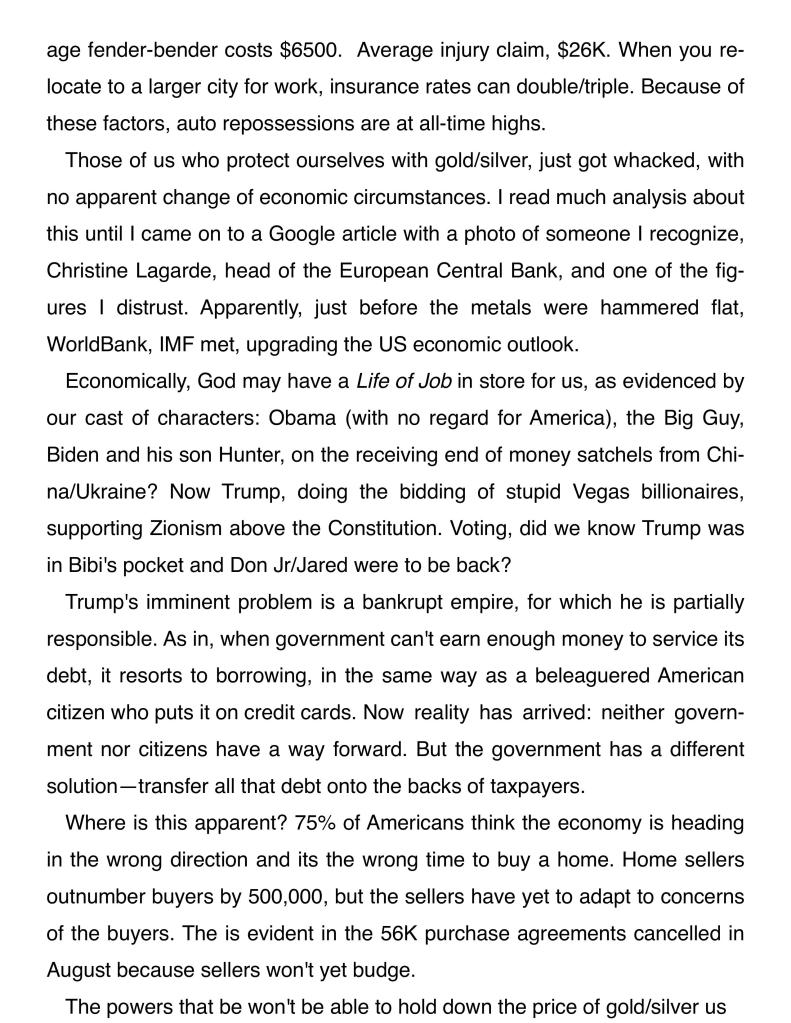
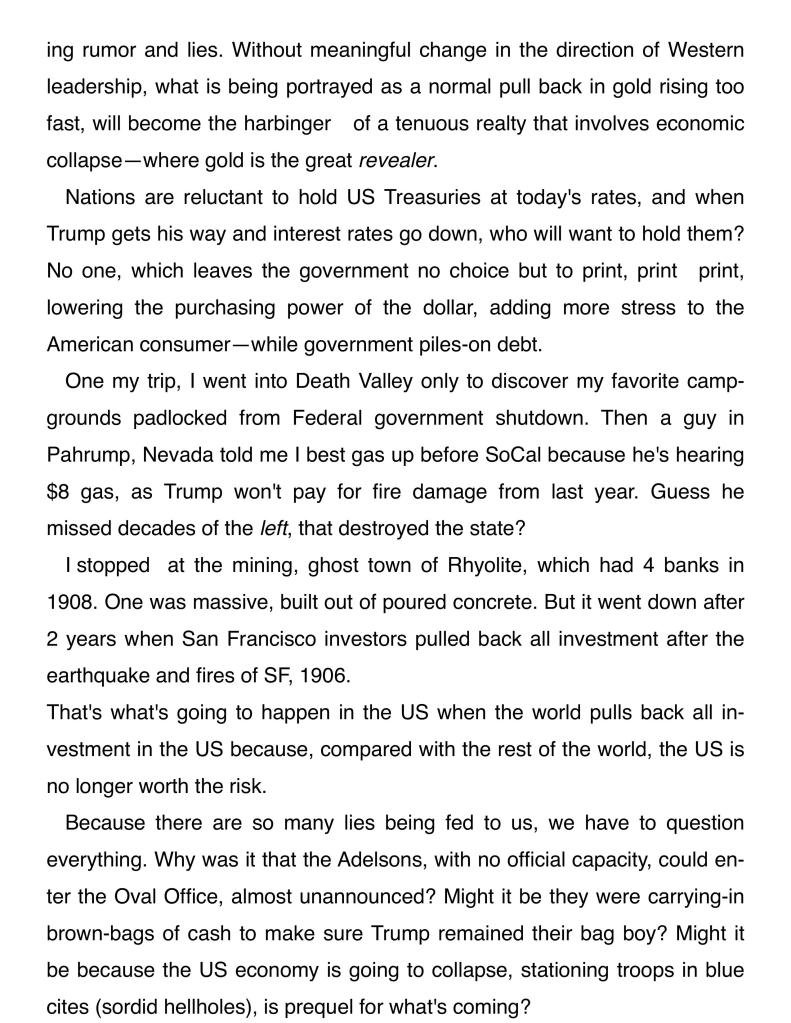
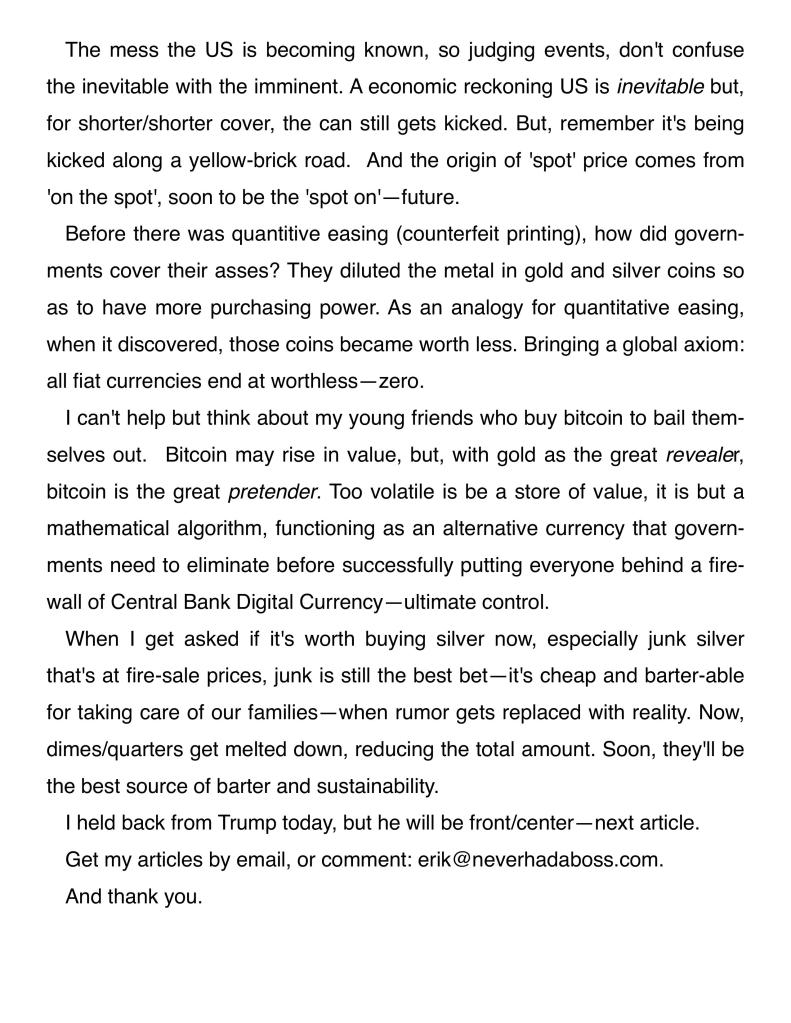
“Erik tells us about the lies, lies, and more lies we are told daily..”
The latest from Erik –

-
Bill’s Commentary:
“And they told us there was plenty of silver around?”
India’s Largest Metals Refinery Ran Out of Silver for the First Time in History
Shortages hit London too. The silver market is broken.

For months, Vipin Raina had been bracing for a stampede of buying from Indian customers loading up on silver to honor the Hindu goddess of wealth.
But when it came, he was still blown away. At the start of last week, his company, India’s largest precious metals refinery, ran out of silver stock for the first time in its history.
-
Bill’s Commentary:
“Always follow the money!”
“Coup d’Flat”: Billionaire-Funded ‘No Kings’ Color-Revolution Turns Into White Liberal Boomer Parade As Dems Become National Laughingstock
The Democratic Party’s dark-money NGO network, bankrolled by left-wing billionaires, unleashed a highly coordinated, color-revolution-style mobilization nationwide on Saturday; the same tactics U.S. intelligence agencies have used overseas for years in regime-change operations. Yet the turnout wasn’t dominated by unhinged young leftists or gender-confused woke warriors, but rather by white baby-boomer liberals, a mobilization effort that NGO expert Mike Benz described as a “Coup d’f́lat.”
The nation is waking up to the fact that dark-money NGO networks, including the Arabella Network, Soros Network, Gates Foundation, Ford Foundation, Tides Foundation, Rockefeller Network, Singham Network, and many others, are funneling millions of dollars into what investigative researchers Peter Schweizer and Seamus Bruner of the Government Accountability Institute call “Riot, Inc.” – the permanent protest industrial complex and the engine behind “No Kings 2.0” partners and organizers. These protests are far from organic; this movement is manufactured, coordinated, and entirely artificial.
Bill’s Commentary:
“JP Morgan tells India “no silver for you”?”
Sold out in India, panic in London: How the silver market broke – The Economic TimesFor months, Vipin Raina had been bracing for a stampede of buying from Indian customers loading up on silver to honor the Hindu goddess of wealth.
But when it came, he was still blown away. At the start of last week, his company, India’s largest precious metals refinery, ran out of silver stock for the first time in its history.
The latest from USA Watchdog –
https://usawatchdog.com/gold-fights-financial-control-grid-catherine-austin-fitts/
-
Bill’s Commentary:
“This is way beyond BAD!”
Bondi DOJ Backs Warrantless Invasion Of Gun Owners’ Homes
The Department of Justice under Attorney General Pam Bondi is advancing an argument that threatens to hollow out the Fourth Amendment’s core protection: that Americans may be secure in their homes against warrantless searches.
The lawsuit is Case v. Montana. After a difficult breakup, William Trevor Case was at home alone when police arrived for a so-called “welfare check.” They spent nearly an hour outside his house. Officers walked around the property, shined flashlights through windows, and even discussed calling his relatives or reaching him directly. They never did. Instead, they retrieved rifles and a ballistic shield, broke down his door without a warrant, and shot him.
Bill’s Commentary:
“Exactly… how much does it pay!!!”
Bill’s Commentary:
“This quote sent in from a reader; “THE WORLD IS CLAMORING FOR SILVER AND GOLD, AND AMERICANS ARE SELLING IT. WHO IS THE THIRD WORLD COUNTRY NOW”?
This is so true! I can tell you as a precious metals broker, I have never seen retail selling like this ever before in my entire career. People are selling because they need the money, Main St. is failing…”
Bill’s Commentary:
“Welcome to the Matrix!”
-
Bill’s Commentary:
“Science has always mattered… even when these leftard asshats abandoned it during the Covid scam…”
15 Democratic Governors Announce Health Alliance to Counter RFK Jr.
The Democratic governors of 14 states and the territory of Guam on Oct. 15 announced a new coalition they said will provide scientific information to counter Health Secretary Robert F. Kennedy Jr.
The Governors Public Health Alliance is aiming to boost coordination between states on public health guidance, preparing for emergencies, and detecting health threats. It plans to issue recommendations to the public on vaccines and other health topics, as the governors say guidance from the federal government can no longer be trusted.
Bill’s Commentary:
“$300 trillion won’t raise any eyebrows in the world we are headed into!”
PayPal’s crypto partner mints a whopping $300 trillion worth of stablecoins in ‘technical error’
Paxos, the blockchain partner of PayPal, mistakenly minted $300 trillion worth of the online payment giant’s stablecoin on Wednesday in what the company called a “technical error.”
Market watchers had spotted the enormous injection of the PayPal PYUSD stablecoin on Etherscan — a block explorer and analytics platform for the Ethereum blockchain.
Paxos had mistakenly minted the stablecoins as part of an internal transfer, before it “immediately identified the error and burned the excess PYUSD,” the company said in a social media statement.
Bill’s Commentary:
“What comes will be a “credit event” of epic proportions!”
Regional Banks Crash As More Credit “Cockroaches” Emerge
Just when the market was starting to finally freak out – with a one month delay – about the Tricolor and First Brands bankruptcy following yesterday’s fingerpointing session between JPM’s Jamie Dimon and various private credit firms in which both accused each other of harboring more credit “cockroaches“, this morning the credit freak out went to 11 as two regional US banks crashed after they both disclosed problems with loans involving allegations of fraud (completely unrelated to Tricolor or First Brands), adding to concern that more cockroaches are indeed emerging in borrowers’ creditworthiness.
Bill’s Commentary:
“And this all happened while gold never had (nor will have) any DEFAILT RISK!”
13 Reasons Why Gold Has Outperformed Stocks Since 2000
The recent increase in gold prices in the United States and around the world has been driven by a confluence of economic, financial, and political factors. This environment, where gold has outperformed U.S. GDP and the four major U.S. stock markets, began in 2000 and has continued to date (see Exhibits 1, 2, 3). We outline 13 reasons why gold has outperformed most major investments and why it is likely to continue attracting individual and institutional investors.
Bill’s Commentary:
“It will be silver as the blasting cap…”
Breaking: Global Silver Shock — LBMA Crisis Forces 88% Draw on COMEX Inventories
Silver’s physical market has just crossed a historic threshold. The CME’s latest report confirms only 173 million troy ounces of registered silver remain in COMEX vaults—metal actually available for delivery. Yet according to ex‑JP Morgan Bullion Bank executive Robert Gottlieb, the London Bullion Market Association (LBMA) must import roughly 150 million ounces to avert systemic failure. In other words, London now needs 88 percent of all COMEX deliverable silver to survive the current liquidity crisis.
The latest from USA Watchdog –

-
Subscribe
Subscribed
Already have a WordPress.com account? Log in now.
 BillHolter.com