Bill’s most recent interview (Also posted under Interviews)
Bill’s Commentary:
“Oops, this is not a rounding error!”
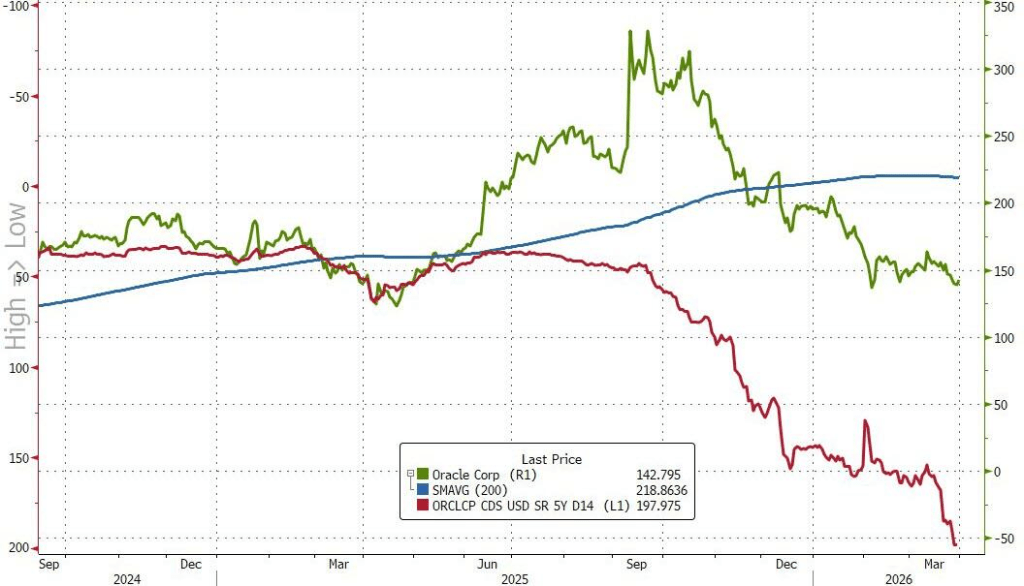
Oracle Firing Tens Of Thousands As CDS Explodes To Financial Crisis Record
Two months ago, when ORCL announced it would raise $50 billion in a combination of stock and bonds to ease market fears about its soaring funding costs and lack of actual revenues and “to build additional capacity to meet the contracted demand from the company’s largest cloud customers, including Advanced Micro Devices, Meta Platforms, Nvidia, OpenAI, TikTok and xAI” we said that this latest example of financial engineering, which perhaps most importantly was meant to push its soaring Credit Default Swap lower, was doomed to fail.
We didn’t have long to wait: since the Feb 1 announcement, the stock has tumbled to fresh multi year lows…
Bill’s Commentary:
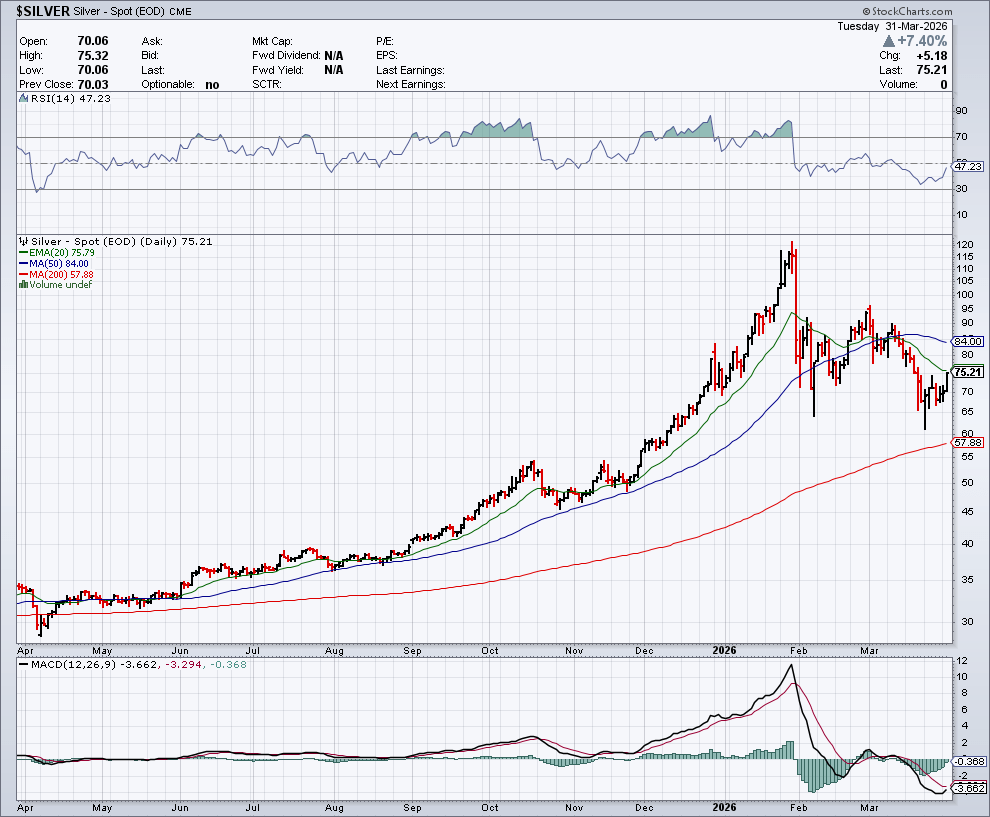
“We have shown this chart to you several times now. Please notice the “hook” forming in the bottom right-hand corner. I believe the bottom is now in and the hook will cross upwards in the next day(s) creating a buy signal for the MOMO crowd. You had two months to the day of clutching your hands, that looks like it will be in the rear view mirror pronto!”
Bill’s Commentary:
“There is no such thing as “digital gold”…”
Google Finds Quantum Computers Could Break Bitcoin Sooner Than Expected
Google just told the Bitcoin and cryptocurrencies industry it has less time than it thought to prepare for the quantum computing influence. In a whitepaper published March 31, Google Quantum AI researchers demonstrated that breaking the elliptic curve cryptography protecting bitcoin, ether and most major cryptocurrencies could require fewer than 500,000 physical qubits on a superconducting quantum computer. That’s roughly a 20 times reduction from prior estimates, which pegged the figure in the millions.
The paper carries serious institutional weight. Its coauthors include Justin Drake of the Ethereum Foundation, Dan Boneh of Stanford, and six Google Quantum AI researchers led by Ryan Babbush and Hartmut Neven. Google says it engaged with the U.S. government before publishing and names Coinbase, the Stanford Institute for Blockchain Research, and the Ethereum Foundation as collaborators.
Breaking Bitcoin with quantum may be easier than thought, with Taproot partly to blame, Google says
Breaking Bitcoin’s blockchain with quantum computers may not be as difficult as once thought, and Bitcoin’s Taproot technology, which enables more efficient, private transactions, may be partly to blame, Google’s Quantum AI team said Monday in a blog post and newly published whitepaper.
The team said the computing power required to break Bitcoin’s security may be far lower than previously assumed, raising fresh questions about how soon quantum threats could become a reality.
In a new whitepaper, researchers found that cracking the cryptography used by Bitcoin and Ethereum could require fewer than 500,000 physical quantum bits, or qubits, well below the “millions” often cited in recent years.
 BillHolter.com